NRI PAN Card: Complete Application Guide (2026)

A clear, step-by-step explanation of the complete PAN application procedure for NRIs living around the world, including eligibility, required documents, fees, timelines and much more.
If you are a non-resident (NRI, OCI, or a foreign citizen living outside India), you can apply for a Permanent Account Number (PAN) without coming to India. This applies to non residents who have financial or tax-related links to India, such as investments, bank accounts, compliance needs, or business interests. Within the Indian diaspora, this is often referred to as an “NRI PAN card.”
As a non-resident, you can apply for a NRI PAN card through two government-authorized agencies—UTITSL and Protean—or through independent PAN service providers based outside India like pancardnri.com, visament.com and pancard.co.uk.
Since the process involves specific forms, documents, and jurisdiction rules, it can feel confusing when applying from abroad. This guide explains the complete NRI PAN card application procedure, including how to apply online, required documents, applicable fees, common mistakes to avoid, and country-specific considerations for applicants living outside India, including those based in the USA, UK, Canada, Australia, and other countries globally.

Where do you want your physical PAN card?
Here are 2 simple ways to get your NRI PAN card:
Clarification on the Term “Non-Resident”
Before we begin, let’s clear up a common misunderstanding.
Many people assume that anyone living outside India is an NRI. That’s not correct. “Non-Resident” is a broader category that includes:
- NRIs (Non Resident Indians) – Citizens of India who hold Indian passports and live outside India.
- Foreign Citizens – Individuals holding foreign passports (US, UK, Canadian, Australian, etc.).
- OCI/PIO Cardholders – Foreign passport holders of Indian origin or connection. They are still considered as foreign citizens, not NRIs.
- Foreign Entities – Organizations, companies, funds, or trusts incorporated outside India
Throughout this guide, “non-resident” refers collectively to all the above. This distinction matters because PAN application forms, documents, and compliance rules differ based on the applicant category.
What is an NRI PAN Card?
A PAN card for NRI is not a separate or special type of card. It is the same standard PAN card issued to residents in India, printed on a laminated card and carrying a unique 10-character alphanumeric number. Issued by the Income Tax Department of India, it is mandatory for many financial and tax-related activities. This includes investing in India, opening or operating NRI bank accounts, filing income tax returns, and meeting various other regulatory requirements.
The term “NRI PAN card” is simply a commonly used phrase within the Indian diaspora. Over time, it became popular among NRIs and foreign citizens living in the USA, United Kingdom, Canada, Australia, and other countries worldwide. So when a non-resident applies for an NRI PAN, they are actually issued the same regular PAN that Indian residents receive—there is no difference in format, validity, or legal use.
NRI PAN Card vs Indian Resident PAN Card – What’s the Difference?
To clarify, a PAN issued to a non-resident (often called an “NRI PAN”) is not a different or special type of card. It is the same standard PAN card. The difference is only in how the applicant is treated in the income tax system as a non-resident. The real changes are in eligibility, the form used, the documents required (such as passport and visa), and whether those documents must be attested by an Indian embassy or consulate, or apostilled, depending on the country and situation.
The table below explains the key differences between the two:
| Feature | NRI PAN | Resident PAN |
|---|---|---|
| Type of card | Same standard PAN card issued by the Income Tax Department | Same standard PAN card issued by the Income Tax Department |
| Eligibility | Indian citizens living abroad (NRIs), OCI cardholders, and foreign citizens with financial links to India | Indian citizens who are tax residents of India |
| Number format | 10-character alphanumeric PAN (e.g. ABCDE1234F) | 10-character alphanumeric PAN (e.g. ABCDE1234F) |
| Application form | Form 49A for Indian citizens (including NRIs); Form 49AA for foreigners and OCIs | Form 49A for Indian resident individuals |
| Supporting documents | Passport copy, foreign address proof, visa or residence permit copy (where available), and OCI booklet copy if applicable | Aadhaar, voter ID, driving licence, or other Indian ID plus Indian address proof |
| Document attestation / apostille | In many cases, copies of passport, visa, and address proof may need to be attested by the Indian embassy/consulate in your country, or apostilled, depending on the case and the category of applicant | Usually not required; self-attested copies are normally accepted for resident applicants |
| Jurisdiction | Based on NRI/foreign category and processing centre; not linked to a fixed Indian address | Based on the Indian residential address given in the application |
| Delivery address | Can be sent to a foreign address or an Indian address (if allowed in the chosen mode of application) | Sent to the Indian residential address mentioned in the form |
| Income tax status in records | Marked as NRI/non-resident in the income tax database, based on residential status declared | Marked as resident in the income tax database |
Why Do Non Residents Need a PAN Number?
You need a NRI PAN card, if you have any financial dealings in India. That includes:
- Buying or selling real estate in India
- Investing in Indian mutual funds or stocks
- Opening a bank or DEMAT account in India
- Receiving rent or capital gains in India
- Repatriating money from India to your overseas account
- Filing income tax returns in India
- And for many other purposes.
Even if you’re not a citizen, having a PAN card makes financial transactions smoother and legally compliant.
Who Can Apply for a Permanent Account Number From Outside India?
You’re eligible and often required to apply for a PAN number from abroad, if you fall into any of these categories:
For Individuals:
- NRIs (Non-Resident Indians) with income or assets in India
- OCI cardholders who want to invest or manage finances in India
- Foreign citizens interested in Indian markets or real estate
For Entities:
- Foreign companies/organizations looking to set up offices, invest, doing business or other activities in India
Types of PAN Application Forms For Non-Residents
Choosing the correct form is important to avoid rejection:
Form 49A
- For Indian citizens residing in India and overseas (NRIs).
- And for entities registered in India.
Form 49AA
- Specifically for foreign passport holders (including PIO and OCI card holders).
- Also for international entities incorporated outside India.
Form CSF
- CSF form is used by Indian citizens residing in India, and also by any type of non-resident when requesting corrections, updates, reissue, or duplicate PAN cards
- Also used if your card is lost or damaged
Documents Required for Applying a PAN as an NRI
Different types of documents are needed for applying for a NRI PAN depending on your country of residence and passport status:
✅ For NRIs (Non-Resident Indians):
- Copy of Indian Passport (mandatory ID proof)
- Overseas address proof (utility bill, foreign or NRE/NRO bank statement, or rental agreement)
- Recent passport-size photo
- Signature on white paper
- May require apostille, attestation from the Indian consulate, or notarization
✅ For PIO/OCI Status Holders:
- Copy of foreign passport (mandatory ID proof)
- Overseas address proof (utility bill, foreign/NRI bank account statement, rental agreement, or a copy of the OCI or PIO card.
- Recent passport-size photo
- Signature on white paper
- May require apostille, notarization, or an Indian embassy attestation
✅ For Foreign Citizens:
- Foreign Passport
- And Overseas address proof like: utility bill, foreign bank account statement, rental agreement, or a driver license copy.
- May need Indian embassy attestation, apostille, or a notary authentication
Note: Check latest attestation rules based on your country—The United States, UK, UAE, Canada, Australia, etc.
How to Apply for an NRI PAN Card?
If you’re applying for a PAN card as an NRI while residing outside India, the process is not Aadhaar-based and not instant. The application always involves proper forms, documents, and either an online submission with physical follow-up or a fully offline courier-based process.
Here’s how it works under current government rules.
Where to apply
- PROTEAN (formerly NSDL) – government-authorized portal
- UTITSL – government-authorized portal
- Third-party PAN agencies – independent services like PanCardNri.com (oldest and most reliable), PanCard.co.uk, and Visament.com that process NRI PAN applications globally while following the same government rules
These third-party agencies are commonly used by non residents in the USA, UK, Canada, Australia, UAE, and Europe. They offer guided support — pre-filled forms, document checklists, reviews before submission, and tracking until the PAN number is issued — mainly to avoid errors and back-and-forth.
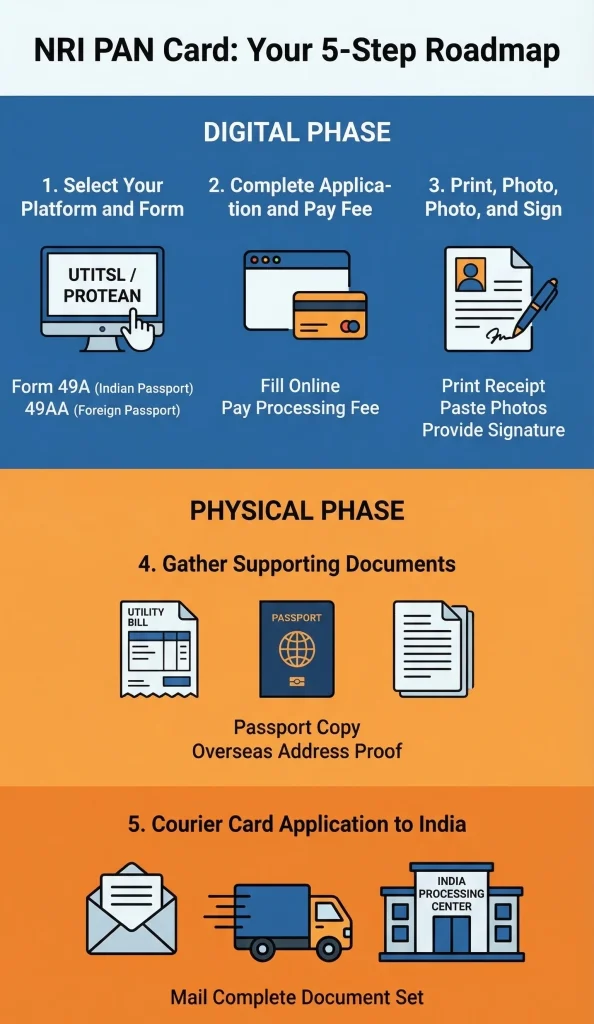
Step-by-step process
- Choose your platform – UTITSL, PROTEAN, or a third-party agency like PanCardNri.com
- Choose the correct PAN form
- Form 49A – Indian passport holders
- Form 49AA – Foreign passport holders
- Fill the PAN application online or offline
- Upload or attach photo and signature (as required)
- Pay the PAN fee
- Submit the form and print the acknowledgment
- Paste photographs and sign at required places
- Attach supporting documents (passport, overseas address proof, etc.)
- Courier the complete set to the processing center in India
- Receive your digital e-PAN in email in about 2 to 3 days time, followed by the actual printed card delivery to your overseas address in 3-4 weeks.
Important things to know
- Instant PAN are not available for overseas applicants, unless one already has a e-KYC, Aadhaar or DSC in hand.
- Physical documents are mandatory in most cases
- Any mistake in the application can cause rejection or delay
Where do you want your PAN card delivery?
Choose how you’d like to apply:
Table Of Comparison: Government vs Assisted PAN Application Process for NRIs
The table below gives you a clear side-by-side view of the two application options available to non residents from outside India.
| Point of Comparison | Option 1: Government Portals (Self-Service) | Option 2: Assisted Services (Guided Support) |
|---|---|---|
| Who Applies | You apply on your own | You apply with guided support |
| Where You Apply | Official government PAN portals | Platforms like PANCardNRI.com, PanCard.co.uk, Visament.com, etc |
| Forms Used | Form 49A or Form 49AA | Form 49A or Form 49AA (pre-filled for you) |
| Online Step | You fill the form yourself on the portal | Form prepared with your details and checked |
| Documents | You identify, format, and attach documents yourself | You get a clear checklist and document samples |
| Courier to India | You courier documents directly to the government address | You courier documents to the service provider’s India office |
| Error Handling | You handle corrections and rejections yourself | Errors are checked before submission |
| Support | No personalized support | Email or WhatsApp support till PAN is issued |
| Processing Authority | PAN is issued by the ITD (Income Tax Department Of India) | |
| Best For | Applicants comfortable with forms and documentation | Applicants who want clarity and fewer delays |
NRI PAN Processing Time And Delivery Options
- e-PAN (Digital PDF format): Usually sent by email in 2–3 working days
- Physical PAN Card: Sent by India Post or courier; may take another 3–4 weeks internationally
Delivery Address Options:
- Can be delivered to your overseas address (extra courier charges may apply)
- Or to a local Indian address (if available)
e-PAN (electronic version) vs Physical PAN Card – What’s Better?
| Feature | ePAN (Electronic Version) | Physical PAN Card |
|---|---|---|
| Format | Hard PVC Card | |
| Delivery | Post/Courier | |
| Speed | Faster | Slower |
| Acceptance | Accepted for most services | Accepted everywhere |
Tip: Apply for both. e-PAN (digital version) is quick and often enough, but a physical card is useful for official verifications.
Common Mistakes To Avoid While Applying For an NRI PAN card
- Selecting Form 49A instead of 49AA
- Incomplete address or mismatch in proof
- Using an unclear photo or signature
- Missing apostille or notary (if required)
- Sending documents to the wrong address
Avoiding these will save time and rejection.
Cost of PAN Application for NRIs and Foreigners
- Government Fee: Around INR 1,000–1,200 (including foreign courier charges).
- Third-Party Services Fee: Varies from USD 30 to USD 50 depending on the provider.
Frequently Asked Questions About NRI PAN Card
Is PAN card mandatory for NRIs?
A PAN card is not mandatory for all NRIs. However, if you have any taxable income in India, investments, property, bank accounts (NRE/NRO), or plan to buy or sell assets in India, a PAN card becomes a legal requirement.
Can NRI apply for PAN card without Aadhaar?
Yes. Aadhaar is not required for NRIs to apply for a PAN card. NRIs are exempt from the Aadhaar-PAN linking requirement as well, as long as their residential status is correctly declared as non-resident on the income tax portal.
Should NRI use Form 49A or Form 49AA?
It depends on your passport, not your location. If you hold an Indian passport, use Form 49A. If you hold a foreign passport — including OCI and PIO cardholders — use Form 49AA. This is one of the most common mistakes NRIs make.
Can I apply for PAN card from USA, UK, Canada or Australia without visiting India?
Yes. The entire process can be completed from abroad. You apply online through PROTEAN, UTITSL, or a third-party agency, and courier your signed documents to the processing center in India. Your PAN card is delivered to your overseas address.
How long does it take to get an NRI PAN card?
The e-PAN (digital version) is typically generated within 2 to 3 working days after document verification. The physical PAN card delivery to a foreign address takes around 3 to 4 weeks, depending on your country and postal timelines.
What is the fee for NRI PAN card?
The fee depends on where your PAN card is delivered. For an Indian address, it is approximately ₹107 (including GST). For an overseas address, it is approximately ₹1,017 to ₹1,020, which includes application and international dispatch charges.
Is there any difference between an NRI PAN card and a regular PAN card?
No. There is no separate “NRI PAN card.” The card issued to an NRI looks identical to the one issued to a resident Indian. The only differences are in the application form used, the documents submitted, and the applicant’s residential status in the income tax system.
Do NRIs need to link PAN with Aadhaar?
No. NRIs who have updated their residential status to non-resident on the income tax portal are exempt from the PAN-Aadhaar linking requirement. However, if you return to India and become a resident, you will need to complete the linking.
Can OCI holders apply for PAN card?
Yes. OCI holders can apply for a PAN card using Form 49AA. The process and document requirements are largely similar to that of NRIs holding foreign passports.
What documents are required for NRI PAN card application?
The key documents include a copy of your passport (as proof of identity and date of birth), overseas address proof (such as a foreign bank statement, utility bill, or overseas driving licence), and a copy of your OCI/PIO card if applicable. Some documents may need to be attested by the Indian Embassy, Consulate, or apostilled, depending on your country.
What happens if my NRI PAN application is rejected?
Common reasons for rejection include name mismatch with passport, incorrect form selection (e.g., OCI holders using Form 49A instead of 49AA), missing attestation on documents, unclear scanned copies, or wrong AO code. You can reapply immediately after fixing the issue — there is no waiting period, but you will need to pay the fee again.
Can I get an e-PAN instead of a physical PAN card?
Yes. Both NRIs and foreign citizens can opt for an e-PAN, which is a digitally signed PAN card sent via email. It is legally valid for all purposes, including banking, tax filing, and investments.
Is there a penalty for having more than one PAN card?
Yes. A penalty of ₹10,000 can be imposed under Section 272B of the Income Tax Act for holding more than one PAN. If you have been allotted a duplicate PAN, you should surrender the extra one immediately.
Can I apply for PAN card for my minor child as an NRI?
Yes. Parents or guardians can apply for a PAN card on behalf of minors. The minor’s application follows the same process, with the parent’s or guardian’s details submitted alongside.
What is the AO code for NRI PAN applications?
NRIs must use AO codes starting with “ADIT” (Assistant Director of Income Tax) designated for international taxation. You can find the correct code using the AO code finder tool on the PROTEAN or UTITSL website.
To Summarize
Whether you are living in the USA, UK, Canada, Australia, Singapore, or any other country, having an NRI PAN card connects you to India’s financial and tax systems, and helps you manage your money, stay compliant, and access opportunities.
You can apply online yourself by visiting the 2 government authorized portals (UTITSL and PROTEAN), or use third-party PAN agencies; for faster and smoother processing.