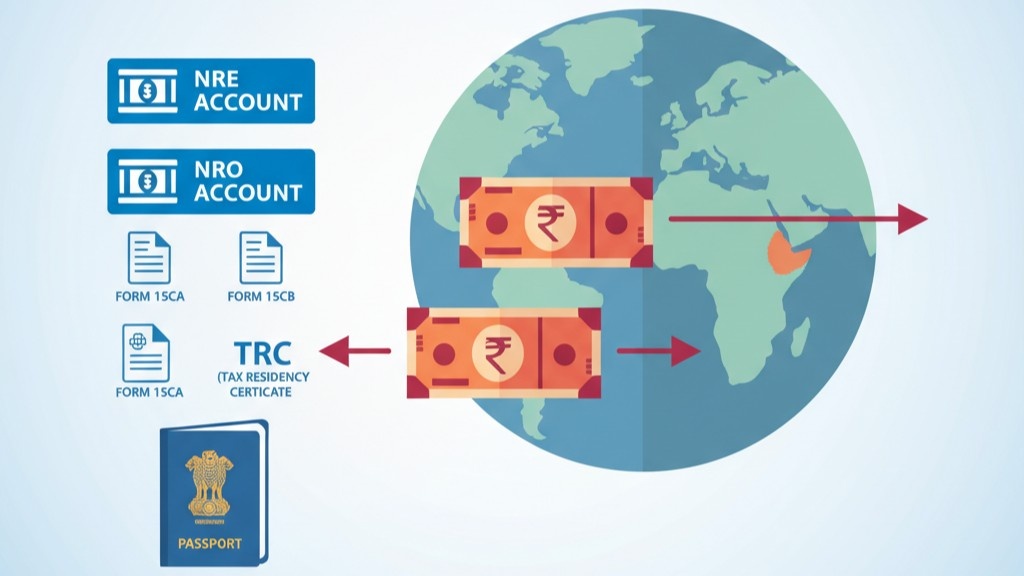
The rate is no longer 20%, the form numbers have all changed, and TDS (Tax Deduction At Source) is charged on your entire sale price — not your profit. Here is what an NRI or OCI holder actually needs to know before selling a Dholera plot in 2026, and the one certificate that stops a fortune being locked up with the tax department.
If you are an NRI planning to sell a plot in Dholera, almost everything you have read about the tax is probably out of date.
Most articles still say the TDS rate is 20%. It is not. Most still refer to Form 15CA, Form 26QB, Form 27Q, and Section 197. All of those were renumbered from 1 April 2026. And nearly all of them skip the single fact that costs Dholera sellers the most money: TDS is deducted on your whole sale price, not on the profit you made.
For a Dholera plot — where the entire investment case is buying cheap land that appreciates sharply — that distinction can mean lakhs of your own money sitting frozen with the government for a year or more.
This guide gives you the correct 2026 position, a worked example with Dholera-style numbers, and the legal route to avoid the trap. If you want the wider picture first, see our complete NRI guide to Dholera real estate.
The thing that shocks NRI sellers: TDS is on the whole sale price
When a resident Indian sells property, the buyer deducts just 1% TDS, and only on the sale value above ₹50 lakh.
When an NRI sells, the rules are completely different. The buyer must deduct TDS at the full capital-gains rate, and — unless you take action in advance — on the entire sale consideration, not on your actual gain.
So if you sell your land in Dholera for ₹75 lakh, TDS (tax deduction at the source) is calculated on the full ₹75 lakh — even if your real profit, and therefore your real tax, is a fraction of that. The excess is not lost forever; you can claim it back as a refund by filing a tax return. But that refund can take many months, and in the meantime your capital is locked and your repatriation is delayed.
That single mechanism is why planning matters so much for NRI sellers.
The correct 2026 rate (it is not 20%)
For years, long-term capital gains on Indian property were taxed at 20% with an indexation benefit, so most websites still show “20% TDS for NRIs.” The Union Budget of July 2024 changed this.
Here is the current position for a sale on or after 1 April 2026, under Section 393(2) of the Income-tax Act, 2025 (this is the successor to the old Section 195):
Long-term capital gains — where you have held the plot for more than 24 months — are taxed at a flat 12.5%, without indexation, plus applicable surcharge and 4% health and education cess. In practice the effective rate ranges from about 13% up to roughly 14.95% at the highest surcharge level.
Short-term capital gains — plot held for 24 months or less — are taxed at your normal slab rates, plus surcharge and cess.
Because Dholera is bought and held as a long-term appreciation play, most sellers will fall on the long-term side and face the 12.5% regime. That is the rate to plan around.
The Dholera math: why gross-value TDS locks up a fortune
This is the section that matters most, because Dholera’s investment story is exactly the scenario where the gross-value rule bites hardest.
The whole appeal of a Dholera plot is a low entry price and sharp appreciation. That means a small cost and a large sale value — and TDS calculated on that large sale value.
A worked example (illustrative)
Suppose an NRI:
Bought a Dholera plot in 2019 for ₹15,00,000
Sells it in 2026 for ₹75,00,000 (held over 24 months, so long-term)
Actual long-term capital gain: ₹60,00,000
Without a lower certificate, the buyer deducts TDS on the full ₹75,00,000. At an effective rate of roughly 13%, that is about ₹9,75,000 withheld before the seller receives anything.
Now look at what is actually owed. Tax on the real gain of ₹60,00,000 at roughly 13% is about ₹7,80,000 — meaning close to ₹2,00,000 has been over-deducted and locked up, recoverable only later as a refund.
And it can be far worse. If the NRI reinvests the gain under an exemption such as Section 54EC or 54F (explained below), the actual tax due could fall dramatically — potentially close to nil. Yet without planning, the buyer would still deduct roughly ₹9,75,000 on the gross value, freezing almost the entire sum for a year or more while a refund is processed.
(Figures are illustrative and simplified; surcharge, cess, and exact computation depend on your total income and should be confirmed with a professional.)
The takeaway: for a Dholera seller, the gap between what is deducted and what is actually owed can be enormous. There is a legal way to close it before the sale — and that is the next section.
The fix: a Lower/Nil TDS Certificate (Section 395, Form 128)
The most important tax-planning step for any NRI selling a Dholera property is to obtain a Lower or Nil TDS Certificatebefore the sale closes.
This is a certificate from the Income Tax Assessing Officer that directs the buyer to deduct TDS at a reduced rate — based on your actual capital gain and real tax liability, rather than the full sale value. In many cases it brings the deduction down sharply; where reinvestment exemptions apply, it can even bring it close to nil.
The current references (from 1 April 2026):
The provision is Section 395 of the Income-tax Act, 2025 (this replaced the old Section 197).
The application is made on Form 128 (this replaced the old Form 13).
It is an online application to the jurisdictional Assessing Officer, supported by your purchase documents, cost of acquisition, and gain computation.
Timing is everything. Processing takes time, so the application should be filed well ahead — generally 30 to 60 days before the expected sale date. Leave it too late and the buyer will be forced to deduct at the full rate on the gross value, and you are back to waiting for a refund.
For most Dholera sellers, this certificate is the difference between receiving nearly all of your money at sale and watching a large chunk of it sit frozen for a year.
We handle this end to end. Our team prepares the gain computation and files your Section 395 / Form 128 Lower TDS Certificate application with the Assessing Officer — well before your sale closes — so TDS is deducted on your real gain, not your gross sale price. Talk to us about your Lower TDS Certificate.
The forms — get them right (2026 numbers)
The 1 April 2026 changeover renumbered every form in this process. Using the old numbers now causes rejected filings and delays. Here is the current set for an NRI sale:
Form 128 — your Lower/Nil TDS Certificate application (old Form 13).
Form 144 — the buyer’s quarterly TDS return for payments to non-residents (old Form 27Q). Filed through the TIN-Protean utility, not the e-filing portal.
Form 132 — the TDS certificate the buyer issues to you afterwards, your proof of the tax deducted (old Form 16B).
One critical warning:Form 141 (the renumbered old Form 26QB) is for resident sellers only and cannot be used when the seller is an NRI. If your buyer files Form 141 for your sale, the filing is defective. For an NRI sale the correct return is Form 144. Getting this wrong is one of the most common — and most damaging — errors in NRI property transactions.
The buyer problem unique to Dholera
There is a practical risk in Dholera that catches sellers off guard: your buyer often does not know these rules.
Many Dholera buyers are resident Indian investors used to the simple 1% resident-to-resident process. Out of habit, they assume the same applies to you — deducting 1% and filing the resident form. When the seller is an NRI, that is wrong on both counts, and the consequences land on both parties:
The buyer becomes liable for the short deduction, with interest and penalties.
Your sale, your TDS credit, and ultimately your repatriation can be blocked until the buyer corrects it.
What to insist on before you sell:
The buyer must obtain a TAN (this remains mandatory until 30 September 2026; a PAN-based route opens only from 1 October 2026, and only for individual and HUF buyers).
TDS must be deducted at the correct capital-gains rate — or at the rate on your Form 128 certificate if you have one.
The buyer must file Form 144, and issue you Form 132.
Agreeing this in writing before the sale saves months of untangling afterwards.
Reducing the tax legally: Sections 54, 54F, and 54EC
Beyond the lower certificate, Indian law offers genuine ways to reduce the capital-gains tax itself — and, when built into your Form 128 application, to reduce the TDS at source too:
Section 54 — exemption where long-term gains from a residential property are reinvested in another residential property in India.
Section 54F — exemption where the net sale proceeds of a long-term asset (such as a plot) are invested in a residential house, subject to conditions.
Section 54EC — exemption where gains are invested in specified bonds (such as NHAI or REC) within six months, up to prescribed limits.
These exemptions apply to NRIs as well as residents. Used correctly, they can meaningfully lower — or in some cases eliminate — the tax on your Dholera sale, which in turn lowers the deduction your certificate authorises.
After TDS: getting your money out (repatriation)
Selling is only half the journey. To send your sale proceeds abroad, you must clear one more compliance step.
Outward remittance of the funds requires a declaration and a chartered accountant’s certificate confirming your tax position. From 1 April 2026 these are filed as Form 145 (the remittance declaration, old Form 15CA) and Form 146 (the CA’s certificate, old Form 15CB). Most banks will not release the outward remittance without both.
Confirmed whether your gain is long-term (held >24 months) or short-term
Understood TDS applies to the full sale price unless you obtain a certificate
Applied for a Lower/Nil TDS Certificate (Section 395, Form 128) — 30–60 days before sale
Factored in Section 54 / 54F / 54EC exemptions in your gain computation
Confirmed the buyer has a TAN (mandatory until 30 Sept 2026)
Ensured the buyer will file Form 144 — not Form 141
Arranged to receive your Form 132 (TDS certificate) after the sale
Planned repatriation via Form 145 / Form 146 and the NRO limit
Questions NRIs commonly ask about TDS on a Dholera sale
Is TDS on my Dholera sale really 20%?
No. That is the old rate. Since the July 2024 Budget, long-term capital gains are taxed at 12.5% (without indexation) plus surcharge and cess — an effective rate of roughly 13% to 14.95%. Short-term gains are taxed at slab rates.
Is TDS charged on the sale price or on my profit?
On the full sale price, by default — not on your profit. This is the biggest trap for NRI sellers. The only way to have TDS applied to your actual gain instead is to obtain a Lower/Nil TDS Certificate (Section 395, Form 128) before the sale.
How do I reduce the TDS on my Dholera property sale?
Apply for a Lower/Nil TDS Certificate under Section 395 using Form 128, ideally 30–60 days before the sale. It directs the buyer to deduct on your real gain rather than the gross value. Reinvestment exemptions under Sections 54, 54F, and 54EC can reduce it further.
Which form does my buyer file — Form 141 or Form 144?
Form 144. Form 141 (the old Form 26QB) is only for resident sellers and cannot be used for an NRI sale. If your buyer uses Form 141, the filing is defective and must be corrected.
Will TDS block my repatriation?
It can, if handled incorrectly. Excess TDS ties up your money until a refund is processed, and outward remittance also requires Form 145 and Form 146. Getting a lower certificate in advance and ensuring correct buyer filings keeps your repatriation on track.
Does my buyer still need a TAN in 2026?
Yes, until 30 September 2026. A simplified PAN-based route opens from 1 October 2026, but only for individual and HUF buyers.
Official sources referenced in this guide
This guide is based on publicly available information from official Indian government and regulatory authorities. Rules and rates are revised periodically; verify the current position before acting.
Income Tax Department of India — Capital gains, TDS on property, Sections 393/395, Forms 128/132/144/145/146 — https://www.incometax.gov.in
Central Board of Direct Taxes (CBDT) — Notifications under the Income-tax Act, 2025 and Income-tax Rules, 2026 — https://www.incometax.gov.in
Reserve Bank of India (RBI) — Repatriation limits and FEMA rules for NRIs — https://www.rbi.org.in
Disclaimer
This article is published for general information only. It is not tax, legal, or investment advice, and it is not a recommendation to buy or sell any property. Tax rates, section numbers, forms, thresholds, and procedures change over time and depend on your individual circumstances. The figures used are illustrative and simplified. Readers should independently verify the current rules on the Income Tax Department portal and consult a qualified chartered accountant or tax professional before acting. The website and author accept no responsibility for decisions made based on this content.
K. Girish is an entrepreneur with over 20 years of experience advising NRIs on cross-border matters — from documentation and compliance to investments and financial processes. With a background in financial markets including forex, bonds, and equities, he runs multiple NRI-focused platforms that make complex India-related procedures easier for the global Indian diaspora.
Most NRI repatriation guides are written for apartments, not plots. This 2026 guide explains how repatriation actually works after selling a Dholera plot: why proceeds must pass through your NRO account, the real shape of the USD 1 million per-year limit, the plot-versus-residential trap that can strand your money for an extra year, and the Form 145 and Form 146 filings your bank will not skip.
A Power of Attorney (POA) is how most NRIs & OCIs buy a Dholera plot without flying to Gujarat — but it is also the document most exploited in Indian property fraud. This guide explains the type of PoA to use, the exact step-by-step process to execute one from your country (with apostille and registration), the Supreme Court “GPA-sale” trap that can cost you your title, and the FEMA limits your representative cannot cross.