NRI Guide to Money Repatriation on Dholera Property Sale

You’ve sold your Dholera property, the tax is deducted — now how do you actually move the money to your country? This is where most NRIs discover that the repatriation rules they read online were written for apartments, not plots. Here is what actually applies to a Dholera land sale in 2026, the accounts and forms involved, and the plot-specific trap that can strand part of your money in India for an extra year.
Selling your Dholera plot is only half the job. Getting the proceeds into your bank account abroad — legally, and without your money sitting frozen — is a separate process with its own rules, and it trips up more NRIs than the sale itself.
The problem is that almost every repatriation guide online is written around residential property: flats and houses. It talks about the “USD 1 million limit” and the “return of your original investment on up to two residential properties.” A Dholera holding is usually a vacant plot — and that single difference can change which rule applies to you.
This guide explains repatriation as it actually works for a Dholera land sale in 2026: the account your money must pass through, the real shape of the USD 1 million rule, the plot-versus-residential trap, and the two forms your bank will not release the money without. For the wider journey, start with our complete NRI guide to Dholera real estate.
First rule: the money goes to your NRO account — always
Whatever account you used to buy the plot, the sale proceeds must first be credited to your NRO (Non-Resident Ordinary) account in India.
This applies even if you originally paid with foreign money through your NRE or FCNR account. There is no route that lets a property sale land directly in your NRE account.
Why it matters: NRE money is freely repatriable, so it is tempting to try to route sale proceeds there directly to skip the limits. Doing so bypasses FEMA’s process and creates exactly the kind of compliance problem that gets a remittance blocked. The correct path is always sale proceeds → NRO account → repatriate abroad, following the steps below.
The USD 1 million rule, correctly stated
Here is the rule that governs almost every Dholera plot sale, stated the way the RBI actually applies it:
An NRI may repatriate up to USD 1 million per financial year (April to March) from their NRO account.
Two details that people consistently get wrong:
- It is per person, per year — not per property. If you sell two plots in the same year, you do not get USD 2 million of headroom. The USD 1 million is an aggregate ceiling across all your NRO remittances that year — property proceeds, rental income, everything combined.
- The financial year boundary is a planning tool. The limit resets every 1 April. A sale closed in mid-March gives you only days before the year rolls over — but if the same sale is timed to close in early April, you have a full fresh year of headroom. For larger sales, timing the closing around the financial year can save you a year of waiting.
For most Dholera plots — where the total proceeds sit comfortably under USD 1 million — the whole amount can be repatriated in a single year. The rule bites only on larger sales, which is exactly where the next section becomes important.
The Dholera plot trap: the “residential property” rules may not apply to you
This is the section that matters most, because it is where generic advice actively misleads Dholera owners.
You will read everywhere that if you bought property with foreign funds, you can repatriate your original investment (the principal) outside the USD 1 million cap, as a simple reversal of the foreign exchange you brought in. That is true — but it comes with a condition almost never stated plainly: this carve-out is framed around residential property, and is capped at two residential properties in your lifetime.
A vacant plot is not a residential house. Until you build on it, it is land. That means the comfortable “get your principal back outside the cap” treatment that applies to a flat cannot be assumed for a Dholera plot. The safest working assumption is that your entire plot proceeds fall under the USD 1 million per year aggregate cap, the same way commercial property does.
Why this matters — a worked example (illustrative)
Suppose an NRI:
- In 2018, remitted USD 200,000 from abroad (through their NRE account) to buy a large Dholera plot.
- In 2026, sells it for the rupee equivalent of USD 1,300,000. After TDS, the net is credited to the NRO account.
- Original principal: USD 200,000. Capital gain: USD 1,100,000.
If this were a residential flat, the owner could expect to repatriate the USD 200,000 principal outside the cap, plus USD 1,000,000 of gain under the cap — around USD 1,200,000 in year one, with the small remainder the next year.
But it is a plot. If the principal carve-out does not apply, the entire USD 1,300,000 sits under the USD 1 million annual ceiling. That means only USD 1,000,000 goes out in year one, and USD 300,000 is stranded in India until the next financial year — USD 200,000 more locked up than the owner expected, purely because they assumed the residential rule.
(Figures are illustrative. Exchange rates, TDS, and your total remittances for the year all affect the real numbers.)
What to do about it
- Do not assume the residential carve-out applies to a plot. Plan around the USD 1 million annual cap.
- If you bought with foreign funds, keep your FIRC (Foreign Inward Remittance Certificate) and original remittance trail. With that proof, there is a reasonable basis to ask your bank to treat the original principal as a return of foreign exchange — but this is bank- and case-dependent, so treat it as an argument to be supported, not a guarantee.
- For larger plots, plan the sale timing and the financial-year split in advance, so nothing is stranded unexpectedly.
This is the exact point where a plot differs from the apartment that most repatriation articles quietly assume you own.
Source of funds decides everything
Beyond the plot nuance, the route your money can take depends on how you originally paid for it:
- Bought with foreign funds (inward remittance, NRE, or FCNR): the original principal has the strongest claim to repatriation, and the gain runs under the USD 1 million cap. Keep your FIRC and remittance evidence — without the original inward-remittance trail, the bank cannot certify a return of principal.
- Bought with rupee funds (NRO account, Indian income, or bought while you were still a resident): the full proceeds fall under the USD 1 million per year cap, with no restriction on the number of properties.
- Inherited: the full proceeds are repatriable under the USD 1 million cap, but you must additionally prove lawful inheritance — a will, legal heir certificate, succession certificate, or probate, as applicable.
In all three cases, the amount you can send is net of the TDS already deducted at sale.
The forms that release your money: Form 145 and Form 146
Your bank will not process an outward remittance from your NRO account on trust. It needs documentary proof that your tax position is clean. Since 1 April 2026, that proof is provided through two renamed forms:
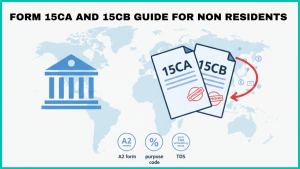
- Form 146 — the certificate issued by a chartered accountant, confirming the nature of the remittance and that the correct tax has been paid or accounted for. (This replaced the old Form 15CB.)
- Form 145 — your own declaration, filed online on the Income Tax portal, referencing the Form 146 certificate. (This replaced the old Form 15CA.)
The sequence is: your CA verifies the transaction and issues Form 146, you file Form 145 quoting its reference, and only then does the AD bank process the remittance. Most banks require both before releasing a single rupee abroad.
If you would like this handled for you, our team can prepare and file your Form 145 and Form 146 so the bank has everything it needs.
TDS must be settled first
Repatriation and tax are linked. Your bank’s certification — and your CA’s Form 146 — depend on the tax on your sale having been correctly deducted and accounted for. If TDS was mishandled at the sale (for example, deducted under the wrong form, or not deposited by the buyer), your repatriation can stall until it is fixed.
This is also why planning the TDS stage well pays off at the repatriation stage: a properly obtained lower TDS certificate means less of your money was withheld in the first place, so there is more to send and fewer refund complications to resolve. We cover this fully in our guide to TDS on selling a Dholera property.
Documents your AD bank will demand
Have these ready before you approach the bank — missing paperwork is the most common cause of delay:
- Sale deed (registered) and the buyer’s payment details
- Original purchase deed and, if bought with foreign funds, the FIRC / inward remittance proof
- TDS certificate (Form 132) from the buyer
- Capital gains computation
- Form 146 (CA certificate) and Form 145 (your declaration)
- NRO account statements
- For inherited property: will, legal heir or succession certificate, or probate
- Your PoA document, if someone is acting on your behalf
Timing and practical traps
- There is no statutory deadline to repatriate — but banks grow reluctant to process remittances tied to transactions that are two to three years old. Aim to complete repatriation within 6 to 12 months of the sale.
- No lock-in applies in 2026 — the older three-year holding restriction on repatriation was removed in earlier FEMA amendments.
- Joint owners each get their own USD 1 million. If a plot is jointly held by two NRIs (say, a couple), each can repatriate up to USD 1 million in the same year, effectively doubling the headroom — provided both are genuine co-owners.
- A PoA holder can execute repatriation on your behalf, which is common for NRIs who cannot travel. The PoA should specifically cover sale and repatriation, and the bank will want the original or a properly attested copy. Our guide to using a Power of Attorney for a Dholera transaction covers how to set this up.
Repatriation checklist for a Dholera sale
- Sale proceeds credited to your NRO account (never directly to NRE)
- TDS settled and Form 132 certificate received
- Confirmed your source of funds route (foreign / rupee / inherited)
- For a plot, planned around the USD 1 million annual cap — not the residential carve-out
- FIRC / remittance proof located if bought with foreign funds
- Form 146 (CA certificate) obtained
- Form 145 filed online, referencing Form 146
- Full document set ready for the AD bank
- Financial-year timing planned for larger sales
- PoA in place if someone is acting for you
Questions NRIs commonly ask about repatriating a Dholera sale
Can the sale proceeds go straight to my NRE account?
No. Property sale proceeds must first be credited to your NRO account, even if you bought the plot with foreign funds. Repatriation to your overseas account happens from the NRO account after the documentation is complete. Routing directly to NRE bypasses FEMA and causes problems.
Is the USD 1 million limit per property or per year?
Per person, per financial year — and it is aggregate. Selling two plots in one year does not give you USD 2 million; all your NRO remittances that year share the single USD 1 million ceiling. Joint owners, however, each have their own USD 1 million.
Do the “two residential properties” repatriation rules apply to my Dholera plot?
Not straightforwardly. That carve-out — repatriating your original principal outside the cap — is framed around residential property. A vacant plot is not a residential house, so the safest approach is to plan around the USD 1 million annual cap. If you bought with foreign funds, keep your FIRC to argue for return of principal, but do not assume it.
What are Form 145 and Form 146?
They are the 2026 replacements for Form 15CA and Form 15CB. Form 146 is a chartered accountant’s certificate confirming your tax position; Form 145 is your online declaration referencing it. Your bank needs both before releasing an outward remittance.
Can my Power of Attorney holder repatriate the money for me?
Yes. A PoA that specifically covers sale and repatriation lets a trusted person handle the process on your behalf. The bank will require the original or a properly attested copy of the PoA.
Is there a deadline to repatriate after selling?
There is no statutory deadline, but banks become reluctant with transactions more than two to three years old. It is best to complete repatriation within 6 to 12 months of the sale.
Official sources referenced in this guide
This guide is based on publicly available information from official Indian regulatory authorities. Rules and limits change; verify the current position before acting.
Reserve Bank of India (RBI) — FEMA repatriation rules, the USD 1 million scheme, and NRO/NRE account regulations — https://www.rbi.org.in
Foreign Exchange Management Act (FEMA), 1999 — The legal framework for repatriation of sale proceeds by NRIs — https://www.rbi.org.in
Income Tax Department of India — Forms 145 and 146, TDS, and capital gains — https://www.incometax.gov.in
TRACES — TDS certificates and reconciliation — https://www.tdscpc.gov.in
Disclaimer
This article is published for general information only. It is not tax, legal, or investment advice, and it is not a recommendation to buy or sell any property. Repatriation limits, FEMA rules, forms, and banking procedures change over time and depend on your individual circumstances and the source of your funds. The figures used are illustrative and simplified. The treatment of vacant plots versus residential property can vary between banks and cases. Readers should independently verify the current rules with the RBI and the Income Tax Department, and consult a qualified chartered accountant, FEMA professional, and their authorised dealer bank before acting. The website and author accept no responsibility for decisions made based on this content.